


.webp)
.jpg?width=1600&name=%5BEN%5D%20Recruiting%20automation%20-%20Website%20image%20-%201220x740%20(1).jpg)
You lose hours every week to repetitive tasks that could run themselves — screening applications, chasing hiring managers for feedback, scheduling interviews, and sending status updates to candidates. While these tasks pile up, candidates wait. And when they wait too long, they leave.
The cost is measurable. Tellent Recruitee's State of Hiring 2025 research found that nearly 60% of applicants abandon long or repetitive hiring processes. Meanwhile, recruiters and hiring managers make decisions on scattered data: notes in emails, feedback lost in chat threads, and interview impressions that never reach the people who need them. Slow processes do not just delay hiring — they weaken hiring decisions.
Recruiting automation addresses this by moving repetitive, rules-based work out of human hands — so you can focus on what requires judgment: evaluating candidates, building relationships, and making final decisions.
This guide explains what recruiting automation is, what you can and should not automate, how to get started, and how Tellent Recruitee supports automations in hiring.
Key takeaways
- Recruiting automation handles rules-based, repetitive tasks — screening, scheduling, status updates — so you spend time on evaluation and relationships instead.
- An applicant tracking system (ATS) is the system of record; automation runs inside it; artificial intelligence (AI) surfaces and organizes information to support decisions.
- EU hiring teams face sustained pressure: job vacancy rates remain elevated in professional and staffing sectors, and skills gaps are the top barrier to transformation through 2030.
- Automating the wrong things erodes trust; final hiring decisions, warmth in rejections, and judgment calls stay human.
- Start small: map your process, pick two to three high-volume tasks, write your templates carefully, and measure before scaling.
What is recruiting automation?
Recruiting automation is the use of rules-based triggers and workflows to handle repetitive hiring tasks — without manual intervention each time.
When a candidate applies, automation can send an acknowledgment email. When they pass a screening stage, it can move them to the next pipeline step and notify the hiring manager. When you schedule an interview, the system can send calendar invites and reminders.
Recruiting automation is not the same as AI, and neither term is interchangeable with an applicant tracking system. Here is how they relate:
| Term | What it does | Example |
|---|---|---|
| Applicant tracking system (ATS) | The system of record that stores candidate data, tracks pipeline stages, and centralizes hiring activity | Tellent Recruitee storing all applicants for a role in one place |
| Recruiting automation | Rules-based triggers that execute actions when conditions are met | “If a candidate reaches the offer stage, send the offer letter template” |
| AI in recruiting | The intelligent layer that surfaces, ranks, or summarizes information to support decisions | AI surfacing candidates whose experience matches a job's requirements |
Automation follows rules you define. AI in recruitment adds a layer of intelligence — it can parse unstructured data, surface patterns, or generate content — but the decision stays with the recruiter and hiring manager. An ATS is where both automation and AI operate, giving teams a single source of truth for every candidate.
Why manual, disconnected hiring slows teams down
If you are hiring in Europe, the pressure is not easing. Eurostat’s Q4 2025 Job Vacancy Statistics show that the EU job vacancy rate was 2.0%, with administrative and support services (including staffing) at 3.2% and professional, scientific, and technical activities at 2.4% — sustained hiring demand in sectors that depend on recruiting speed.
At the same time, the World Economic Forum’s Future of Jobs Report 2025 identifies skills gaps as the top barrier to business transformation for 2025-2030, cited by 63% of employers globally. Competition for qualified candidates is not going away.
Against this backdrop, manual and disconnected hiring processes create friction at three levels.
For the team: Recruiters spend hours on manual tasks in recruitment — copying candidate details between tools, sending the same emails repeatedly, and chasing hiring managers for feedback. Every manual step is a delay, and every delay is time a candidate might accept another offer.
For the company: Fragmented tools make visibility difficult. When candidate data lives in spreadsheets, email threads, and separate calendars, hiring managers cannot see pipeline status, recruiters cannot identify bottlenecks, and leadership cannot report on what is working. Decisions get made on incomplete information.
For the market: Slow hiring cycles hurt employer reputation. The longer a process drags on, the more likely strong candidates are to accept competing offers or drop out before the final stage — and a slow, frustrating experience damages the employer brand long after one role closes. Candidates do not wait — they move on, and so does the talent market.
What an effective recruiting automation workflow should achieve
Before choosing what to automate, define what a better process looks like. An effective recruiting automation workflow should meet five criteria.
Faster, not rushed
Automation should reduce the time candidates spend waiting — for acknowledgments, for interview scheduling, for status updates — without pushing decisions before they are ready. Speed means fewer delays, not fewer conversations.
More consistent
Every candidate should receive timely communication and move through the same structured process. Automation removes the variability of “I forgot to send that email” or “The hiring manager never responded.”
Better candidate experience
Candidates notice when they receive quick responses, clear next steps, and respectful communication — even rejections. Automation makes a better candidate experience possible at scale without adding recruiter workload.
Measurable
When you automate and centralize workflows, you can measure them: time in each stage, response rates, drop-off points, source effectiveness. Without data, improvement is guesswork.
Human decisions preserved
Automation handles the mechanics. The recruiter and hiring manager make the calls: who to interview, who to hire, how to deliver difficult news. This is not optional — it is the line that keeps hiring fair and defensible.
What you can automate in recruiting
You may underestimate how much of your recruiting workload you can automate. LinkedIn’s Future of Recruiting 2025 report found that, globally, 37% of talent-acquisition organizations are now actively integrating or experimenting with generative AI — up from 27% a year ago — and recruiters using it self-report saving about 20% of their work week.
The opportunity is not limited to AI. Below are the tasks you can automate with rules-based workflows — and how Tellent Recruitee supports each one.
Job posting and sourcing
The problem: Posting jobs manually to multiple boards is time-consuming and error-prone. Formatting requirements differ, and updates have to be made in several places.
The improved process: A single job post publishes to multiple channels at once, with updates synced automatically.
How Tellent Recruitee supports it: Tellent Recruitee’s multi-posting feature lets you publish to multiple job boards and social channels from one place. When you update the job description, the changes propagate automatically — no need to log into each platform separately.

The outcome: Broader reach with less manual posting, and consistent job information across every channel.
Pre-screening and knock-out questions
The problem: Screening resumes manually takes hours, especially for high-volume roles. Recruiters need to read through dozens of applications just to identify who meets basic requirements.
The improved process: Candidates answer qualifying questions when they apply. The workflow flags candidates who do not meet must-have criteria, so you can quickly move past applications that don't fit.
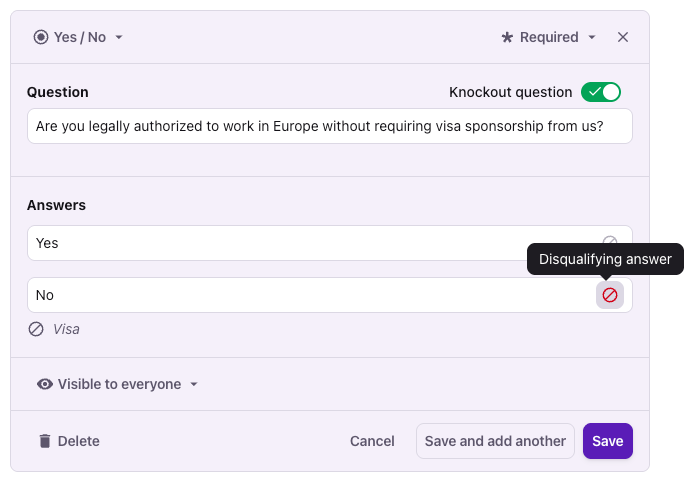
How Tellent Recruitee supports it: Knockout questions in Tellent Recruitee let you define disqualifying criteria yourself, like required certifications, location, availability, or language proficiency. Candidates who do not meet these criteria are moved to a 'disqualified' stage for you to confirm, while candidates who meet them advance for review.
The outcome: Recruiters spend time evaluating candidates who could actually be hired, not filtering out those who cannot.
Interview scheduling
The problem: Coordinating calendars between candidates, recruiters, and hiring managers generates endless email threads. Each back-and-forth exchange adds days to the process.
The improved process: Candidates book their own interview slots from available times, with automatic calendar invites and reminders.
How Tellent Recruitee supports it: The event scheduler in Tellent Recruitee lets candidates self-book interviews based on your team’s real-time availability. Confirmations and reminders go out automatically, and candidates can reschedule without recruiter involvement.

The outcome: Interviews get scheduled in hours instead of days, and recruiters stop playing calendar coordinator.
Candidate communication and updates
The problem: Candidates want to know where they stand. When recruiters are busy, status updates get delayed — or forgotten. Silence damages employer brand.
The improved process: Candidates receive timely, personalized communication at every stage: application received, moving forward, interview scheduled, decision made.
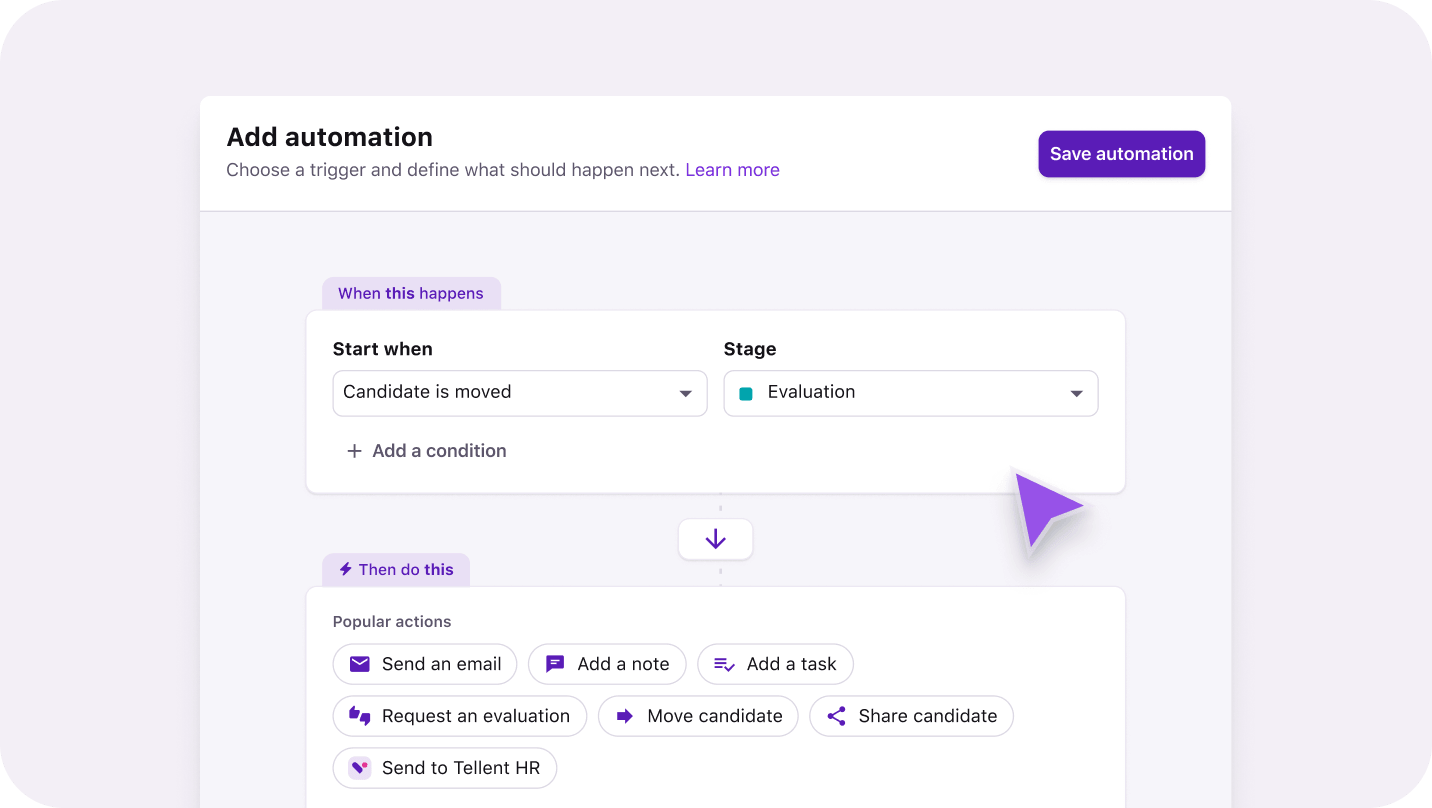
How Tellent Recruitee supports it: Workflow automations in Tellent Recruitee trigger templated emails based on pipeline actions. When a candidate moves to “Interview scheduled,” the system sends the confirmation email automatically. The delayed-send feature lets you add a buffer — so if you realize you made a mistake, you can correct it before the message goes out.
The outcome: Every candidate gets a response, and recruiters do not have to remember to send it.
Reporting and insights
The problem: Without centralized data, reporting is a manual exercise: exporting spreadsheets, reconciling numbers, and guessing at what the data means.
The improved process: Real-time dashboards show pipeline health, source effectiveness, time in stage, and hiring velocity — without manual data pulls.
How Tellent Recruitee supports it: Tellent Recruitee includes 100+ reporting dashboards that update in real time. You can track time-to-hire, identify bottlenecks, compare source performance, and share reports with leadership without building them from scratch.

The outcome: Data-driven decisions, less time spent reporting, and clear visibility for everyone involved in hiring.
What to keep human in recruiting automation
Automation works best when it handles the mechanics — the scheduling, the status updates, the data entry — so humans can focus on the parts of hiring that require judgment. But the line matters. Cross it, and you lose the trust that makes hiring work.
Final hiring decisions stay human
AI can surface information — which candidates match the requirements, what their experience suggests, how they compare to the pool — but the recruiter and hiring manager decide. Automating this decision removes accountability and introduces risk you cannot explain or defend.
Warmth in rejections requires care
A templated rejection email can feel cold. That does not mean you cannot automate it — it means you have to invest time up front to write templates that read warm, not impersonal. Mention the specific role. Thank the candidate for their time. Offer a reason if you can.
Add a buffer before automated messages are sent
Tellent Recruitee’s delayed-send feature exists for a reason. A short delay between screening and the automated rejection message gives you time to catch a mistake before the candidate sees it. Speed is good; irreversible speed is risky.
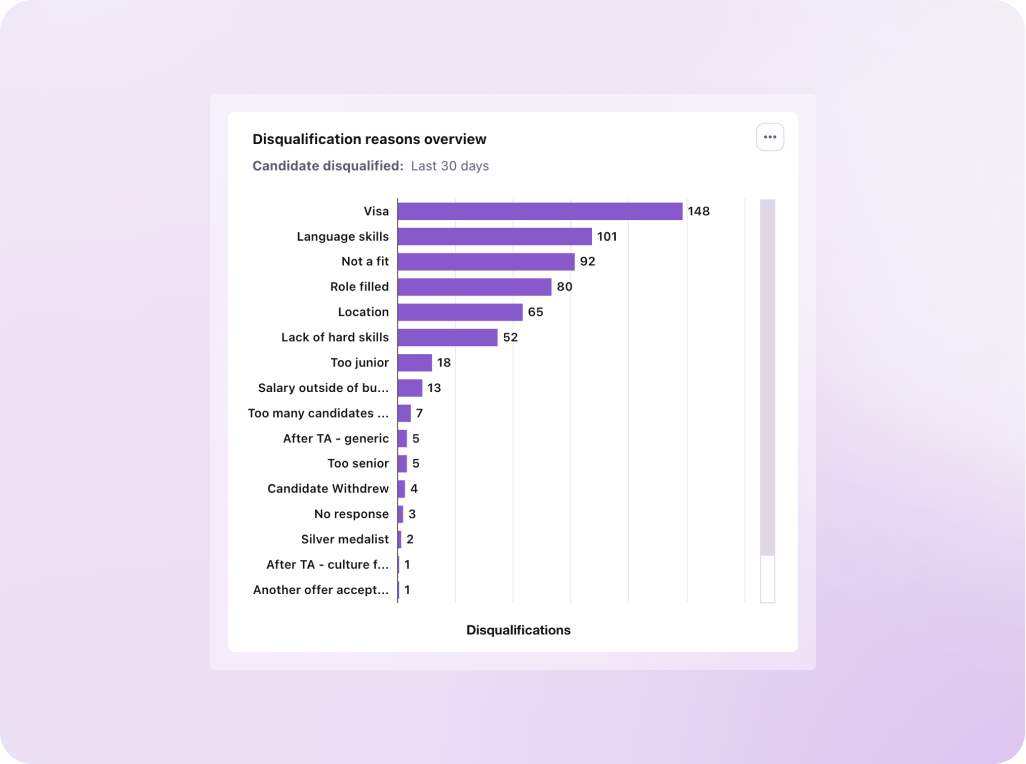
Use specific rejection reasons so the data reveals trends
“Not a fit” tells you nothing. “Missing required certification” or “Salary expectations above range” creates data you can analyze — and patterns you can act on.
Automation handles the repetitive work. You and your hiring managers handle the judgment calls, the empathy, and the accountability.
How to get started with recruiting automation
Starting with recruiting automation does not require a full process overhaul. Begin with the highest-impact tasks and expand from there.
1. Map your current process
Document every step from job requisition to signed offer. Note where candidates wait, where recruiters spend the most time, and where information gets lost.
This matters because you cannot automate what you do not understand. Many teams discover that their “process” is actually a set of habits that vary by recruiter or role.
Example: A mid-size company mapped their hiring process and found that candidates waited an average of five days between application and first response — not because of evaluation time, but because no one owned the acknowledgment email.
Common mistake: Automating an inefficient process. If your current workflow has unnecessary steps, automation will execute them faster — but they will still be unnecessary.
Success looks like: A clear diagram showing every stage, who owns it, what triggers movement to the next stage, and where delays typically occur.
2. Pick two to three high-volume tasks to automate first
Choose tasks that are repetitive, rules-based, and time-consuming. Good task candidates to consider: application acknowledgment emails, interview scheduling, and status update notifications.
This matters because starting small lets you learn how automation works in your context before scaling. Automating everything at once creates confusion and makes it harder to identify what is working.
Example: A recruiting team automates interview scheduling first. Within a couple of weeks, the time from “interview requested” to “interview scheduled” drops sharply because candidates self-book instead of waiting on email.
Common mistake: Choosing tasks that require judgment. Automating candidate evaluation or rejection decisions before screening creates legal and ethical risk.
Success looks like: Two to three automations running reliably, with clear metrics showing their impact.
3. Write your templates carefully
Automated emails represent your employer brand. Spend time crafting messages that are clear, warm, and specific to the role.
This matters because candidates do not know — and should not be able to tell — that a message was automated. A robotic email damages your reputation even if it arrives quickly.
Example: Instead of “Thank you for applying. We will review your application and get back to you,” write: “Thank you for applying for the Senior Product Designer role at [Company]. Our team is reviewing applications this week, and we will update you on next steps by [date].”
Common mistake: Using generic templates that feel impersonal. Worse: templates with placeholder text that was never replaced.
Success looks like: Templates that mention the specific role, set clear expectations, and read like a human wrote them.
4. Add human checkpoints at critical stages
Automation should never send a rejection without a human reviewing the decision. Build in approval steps before high-stakes actions.
This matters because mistakes happen. A candidate might be incorrectly disqualified by a knockout question. A hiring manager might change their mind after a rejection email is queued.
Example: A company sets a two-hour delay on their rejection emails. That buffer catches disqualification mistakes — candidates flagged in error — before an incorrect rejection ever reaches them.
Common mistake: Trusting automation completely. Rules-based systems follow rules; they do not catch exceptions or context.
Success looks like: A clear policy stating which actions require human approval before automation executes.
5. Measure and iterate
Track the impact of each automation: time saved, candidate response rates, error rates, and hiring velocity. Use the data to improve.
This matters because automation is not “set and forget.” Workflows that worked six months ago might need adjustment as your hiring volume or process changes.
Example: A team notices that their automated interview reminder emails have a low open rate. They test a shorter subject line and watch open rates climb.
Common mistake: Measuring activity instead of outcomes. Counting emails sent is not useful; measuring time to hire and candidate satisfaction is.
Success looks like: A monthly review of automation performance, with adjustments based on data.
How Tellent Recruitee supports automated hiring
The impact of recruiting automation compounds when it runs inside a system designed for collaborative hiring. Tellent recruitee.probines automation, AI, and a centralized ATS, so teams can move faster without losing visibility or control.
The numbers show what is possible. Tellent Recruitee's customer survey found that teams automate up to 80% of manual recruiting tasks and spend 64% less time on hiring administration after adopting the platform. When recruiters stop managing spreadsheets and chasing updates, they can focus on evaluation and candidate relationships — the work that actually improves hiring outcomes.
One customer example makes the impact concrete: Livestorm cut their time-to-hire by 58%, from 60 days to 25 days.
Tellent Recruitee supports this through capabilities that work as one connected system, not five separate tools.
A candidate applies, and knockout questions instantly filter for must-have criteria. Qualified candidates self-book a slot through the event scheduler — no back-and-forth. Workflow automations move each profile forward the moment a hiring manager acts, while templated emails with delayed send keep candidates updated at every stage without risking a mistake going out unchecked. Recruiters watch it all in real time across 100+ reporting dashboards, catching bottlenecks before they cost time.
Every solution ties to an outcome: less time on admin, faster decisions, better candidate experience, and defensible, auditable processes.
Conclusion
Recruiting automation is not about removing humans from hiring — it's about removing the repetitive work that keeps you from doing what you do best. When scheduling, status updates, and data entry run automatically, you can focus on evaluation, relationships, and decisions.
Tellent Recruitee brings automation, AI, and collaborative hiring into one platform — so your team can reduce time-to-hire, improve candidate experience, and make defensible decisions at scale.